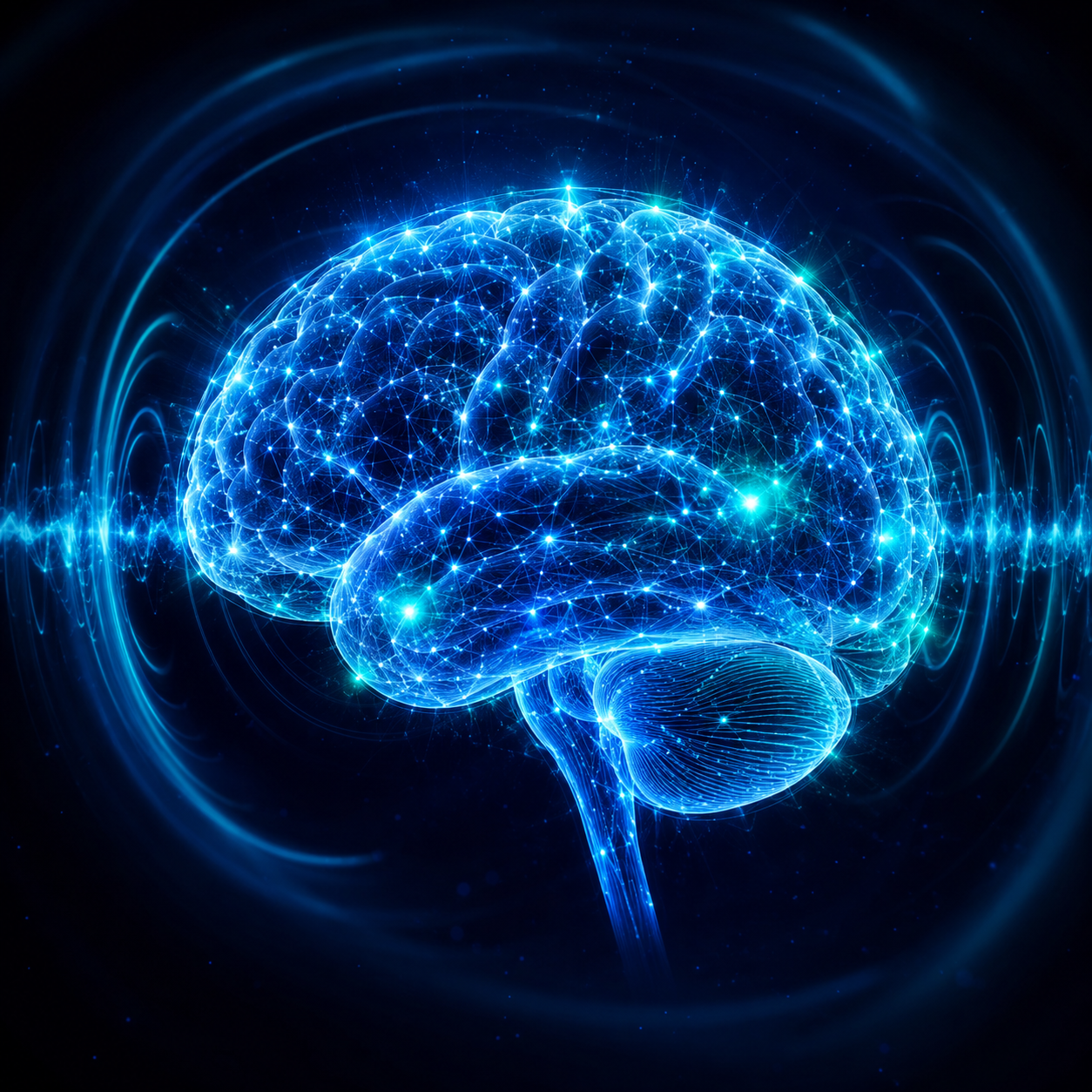
The Strange 7-Second Sound That Switches Your Foggy Brain Back to Calm & Clear
14,000+ adults over 40 have gone from brain fog to sharp, calm focus using this simple daily sound — no pills, no hour-long meditation.

- Clears the 3 p.m. brain fog without caffeine or a crash
- Works through any headphones in just 7 minutes a day
- Backed by real polyvagal science — not a fad
First, a Quick Story — Because It Might Be Yours Too
Let me tell you about the afternoon I stood in my own kitchen…and couldn’t remember my daughter’s phone number.
Not a stranger’s. Not some password. My daughter’s — the number I’d dialed a thousand times. I just stood there, phone in hand, feeling something cold crawl up the back of my neck.
Because it wasn’t the first time. It was just the first time I let myself feel afraid of it.
For about a year the fog had been creeping in. I’d walk into a room and forget why. Re-read the same paragraph three times and still not hold it. In meetings, the word I wanted would sit just out of reach — and then dissolve while someone else said it for me.
And the cruelest part? I was exhausted by all of it… but I couldn’t relax. At night I’d lie there wired, mind grinding through the day on a loop. In the morning I’d wake up feeling like I’d run a marathon in my sleep. Tired. Tense. Foggy. Repeat.
Here’s the thing he got half right. It was stress. He was just wrong that nothing could be done about it — because that “stress” turned out to be the exact mechanism behind the fog, and the exact lever I could pull to switch it off. I just had to understand what was really happening first.
It is not early dementia.It is not “just getting older.”And it is almost never a memory problem at all.

If you walk into a room and forget why… lose a word that is right on the tip of your tongue… or feel wired-but-tired by 3 p.m. — there is a single, overlooked cause behind all of it.
Your nervous system is stuck in “fight-or-flight.” Modern life never lets it switch off, so your body stays flooded with cortisol — and quietly pulls energy away from your thinking brain.

For a long time I told myself the fog was just an annoyance. A few forgotten words. Nothing serious. That’s the lie it tells you while it quietly takes more.
Because brain fog doesn’t stay in your head. It leaks into everything.
It leaks into your work — double-checking what used to be easy, quietly terrified someone will notice you’ve lost a step. Into your confidence — you stop speaking up, because you’re not sure the word will be there when you reach for it.
And into your relationships — physically at the dinner table, mentally three miles away. You snap over nothing, then lie awake marinating in guilt — which spikes the stress again, which deepens the fog tomorrow.
But spirals run both directions. The same loop that drags you down can be turned around — calm feeds clarity, clarity lowers stress, and round that goes, a little better each week. The whole game is flipping which way the loop turns. Hold that thought — it’s exactly what The Cortexa Frequency is built to do.
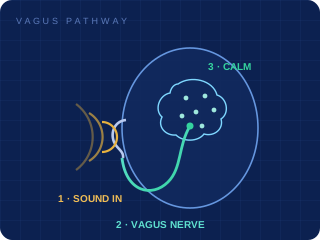
Buried in your body is the master cable of your “rest-and-restore” system: the vagus nerve. When it is active, cortisol drains away, blood returns to the thinking brain, and the fog lifts on its own.
And here is the remarkable part — one branch of it surfaces in exactly one place you can reach from the outside: your ear. Which means it can be gently nudged… by sound.

Long before anyone could measure a nervous system, monks chanted, mothers hummed, and entire traditions were built on the long, low tones of Om and singing bowls. They could not explain why it calmed the mind. They only knew it did.
Now we know why. Those low, steady sounds gently stimulate the vagus nerve through the ear — tipping the whole body out of stress and into calm. Our ancestors found the off-switch by instinct. Science just confirmed it.
As the stress response settles, fast jagged brain activity smooths into slower, calmer waves.
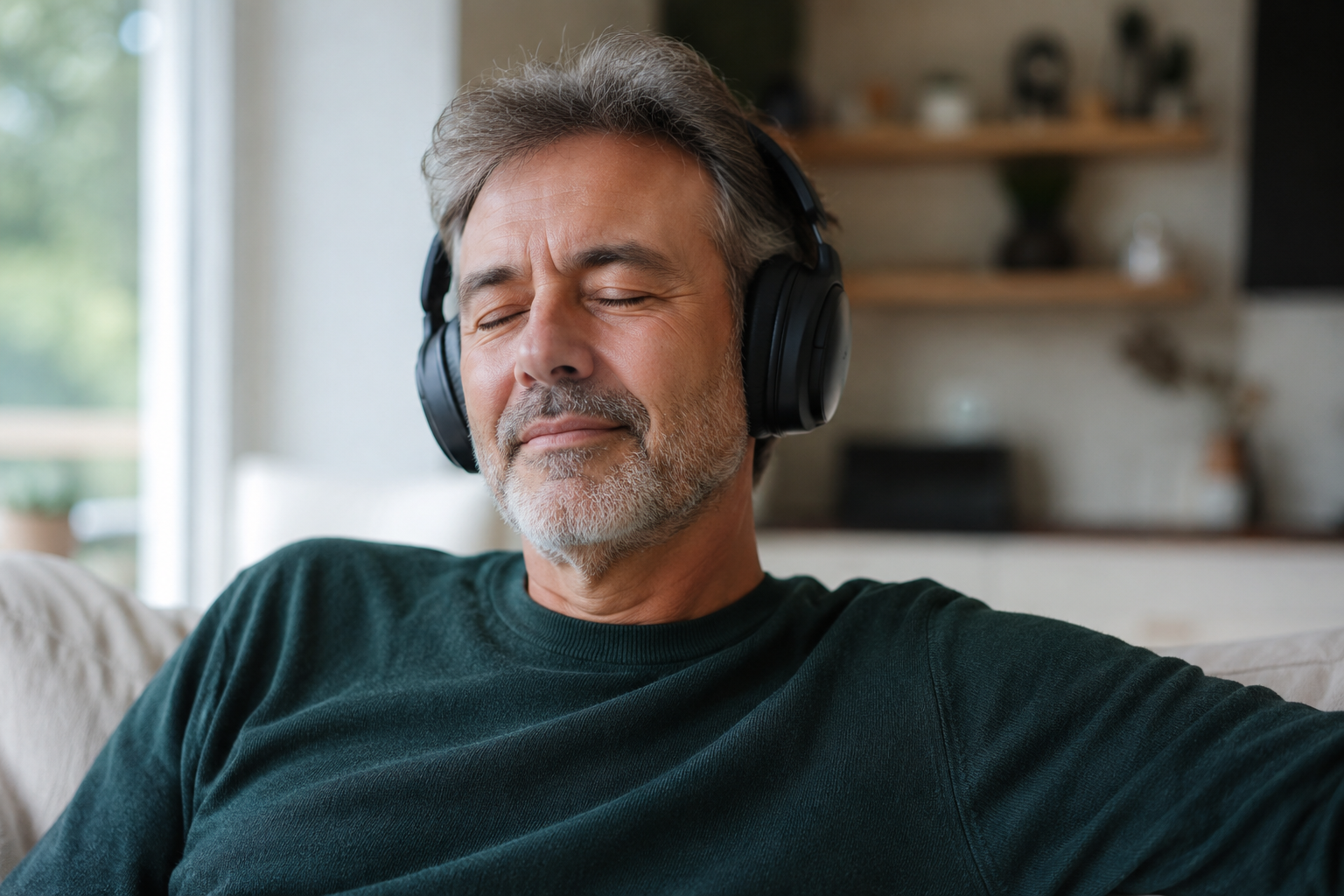
That deep-exhale calm — in 7 minutes, eyes closed

That in-the-zone focus — the rest of your day
One Level Deeper, for the Skeptics
You don’t need any of this for it to work — press play and the sound does its job either way. But if you’re like me and you trust things more when you can see the gears turning, here’s a little more of the machinery.
Scientists actually have a way to measure how well your “rest-and-restore” system is working: heart rate variability — the tiny, healthy variations between your heartbeats. High variability means a flexible, well-toned vagus nerve. Low variability is the signature of a system stuck in stress.
And here’s what researchers keep finding: slow, rhythmic, resonant sound nudges that variability in the healthy direction. Different traditions, same lever — rhythm and resonance, speaking directly to the vagus nerve.
More coffee
Shoves an already-stressed nervous system harder into fight-or-flight. Ninety good minutes, then the crash — and thicker fog. It masks the problem; it never fixes it.
Brain-training apps
You get better at the game. Real-life recall barely moves. It trains a skill — it does not change the gear your nervous system is stuck in.
“Just meditate”
Sitting still with a racing mind for 30 minutes is the opposite of relaxing for most people — so they quit by week two. Wonderful in theory, brutal in practice.
A vagus-nerve sound — the only one that works with your biology
No willpower, no skill, no crash. You press play and the sound does the work — gently engaging the off-switch through your ears. That is The Cortexa Frequency.
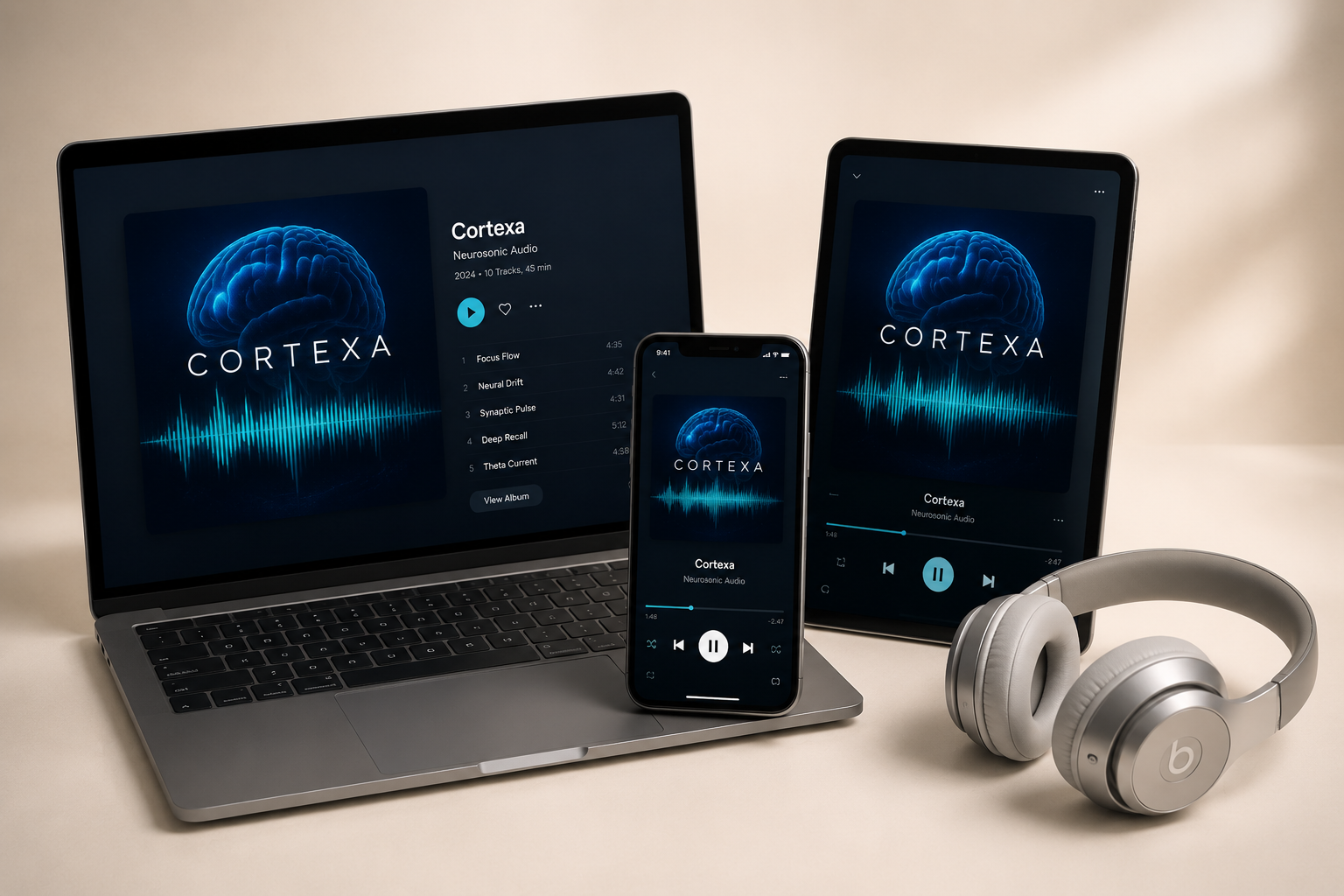
A 7-minute audio track. Three engineered layers of sound. Press play, put on any headphones, and let it do the work — no technique to learn, no way to do it wrong.
- The Vagal Tone — a low frequency tuned to engage the vagus nerve through the ear
- The Carrier Wave — eases your brain out of stressed “beta” chatter into calm focus
- The Calm Bed — a soft soundscape that feels like the deepest exhale in years

Knowing the mechanism is one thing. Turning it into something that works in your earbuds on a Tuesday afternoon is another. I’m not an audio engineer — so I found one. A brilliant, slightly obsessive sound designer who understood exactly how layered frequencies move through the human ear.
We spent the better part of a year on it. Version after version — tested on me, on friends, on anyone who’d put on headphones and tell us the truth. We threw most of them away.
I’ll never forget the first time the finished version worked on me. Fog rolling in, jaw tight. I pressed play, half-expecting nothing. Seven minutes later I opened my eyes and the world was… quieter. Not drugged. Not drowsy. Clear. Like someone opened a window in a stuffy room I’d been sitting in for two years.
“But why sound? Why not just breathe?”
Fair question — I asked it myself. Three reasons it works when the others fizzle out:
- It bypasses the part of you that’s the problem. Breathing drills ask your stressed mind to do something right. Sound asks nothing — you just listen, which your ears do automatically.
- The ear is a direct line. The vagus branch surfaces right there — sound reaches it gently, the same way every time.
- It’s effortless enough to actually repeat. The best intervention on earth is worthless if you quit in nine days. Pressing play is easy — and easy is what becomes a habit.
Let me walk you through it, so it’s not a mystery when you press play tonight. You find a chair. Headphones on. Eyes closed. You press play.
The first thing you notice is the Calm Bed — that soft ambient layer rolling in like a tide. Your shoulders, up around your ears all day without your permission, remember they’re allowed to come down. Around the one-minute mark, your breathing slows on its own — you didn’t tell it to.
By minute three, the chatter gets quieter. Further away. Like a TV in another room. The Carrier Wave is easing your brain out of its jagged, stressed rhythm.
Around minute five, most people feel the drop — a softening behind the eyes, a loosening in the jaw, a single deeper breath that arrives from nowhere. That’s your nervous system finding the other gear.
Here’s a pleasant surprise almost everyone reports. Because the vagus nerve governs your whole “rest-and-restore” system — not just focus — calming it tends to ripple outward:
- Sleep. A nervous system that finally stands down at night falls asleep faster and wakes less. For many, it’s the very first thing they notice.
- A steadier mood. Less hair-trigger reactivity. More space between what happens and how you respond.
- A calmer body. Slower resting heartbeat, easier digestion — both run on that same rest-and-restore branch.
- That “back” feeling. Present. Patient. Like yourself again.
To be clear and honest: this is a wellness recording, not a medical treatment, and not a cure for any condition. But when the system that runs your calm comes back online, you tend to feel it in more than one place.
Imagine 30 Days From Now…
- The name arrives before the face has finished turning toward you
- 3 p.m. comes… and the wall doesn’t
- You sit down to the hard task and your mind is quiet enough to actually do it
- You lie down at night and your body finally lets go



No bottle to wait for. The moment you order, The Cortexa Frequency and 3 free bonuses land in your inbox — ready to play tonight.
(365-Day Money-Back Guarantee)
365-day money-back guarantee · one-time payment · no subscription

“Headphones on at lunch, and by mid-afternoon the fog had lifted — and I wasn’t wired the way coffee makes me. First thing in years that changed something.”

“I always felt tense and scattered, like forty browser tabs open. Seven minutes of this is the first thing that ever quiets my head. Names come back to me now.”
“No app to fight with, nothing to learn. I press play. By the end it feels like someone opened a window in my head. I bought the whole library a week later.”

“I was a total skeptic — thought it was just relaxing music. It is not. I get more done in a morning now than I used to in a day.”

“The sleep one alone was worth it. I had not slept through the night in years. Now I drift off before it even finishes.”

“At 65 I figured fog was just my age. Two weeks in and the words come back to me again. My wife noticed before I said anything.”
Illustrative photos to protect customer privacy. Individual results vary.
Early on, a woman named Margaret, 63, wrote to us. Recently retired, she said the fog had stolen the thing she looked forward to most — time with her grandchildren.
She’d sit with them and lose the thread of their stories. Forget what she’d just been told. She started declining visits because she felt embarrassed — then sat home alone, feeling the world get smaller.
She almost didn’t try it. “I assumed it was nonsense,” she told us later. But the year-long guarantee meant she had nothing to lose, so she pressed play.
Story shared with permission; details adjusted for privacy. Individual results vary and are not guaranteed.
I’d rather you skip this than buy something that isn’t for you. So let me be plain about both sides.
This is very likely for you if…
- You feel foggy, forgetful, or a step slower — and “it’s just your age” never sat right
- You’re wired-but-tired: stressed, stretched thin, unable to switch off
- You’ve tried the pills and apps and you’re tired of things that ask a lot and give little
- You can find 7 quiet minutes a day and own a pair of headphones
This is probably not for you if…
- ✗You want a magic pill that asks nothing — even 7 easy minutes is still a daily habit
- ✗You expect to be a different person after one listen — the calm is immediate, the deeper change builds over weeks
- ✗You have a medical condition you’re hoping this treats — please see a professional; this is for wellbeing, not diagnosis
This is the only place to get The Cortexa Frequency.The launch price on this page is exactly that — a launch price. It will not last.
Honestly, I trust the skeptics more — I was the biggest one. So let me answer the doubts I had myself.
“This sounds too simple to work.”
Simple isn’t the same as weak. Your vagus nerve is a real, physical off-switch — reaching it through sound is gentle by design. The hard, expensive, complicated stuff is exactly what failed both of us before.
“How is this different from free rain sounds?”
Rain sounds are pleasant noise with no target. This is engineered, layer by layer, around the vagus-and-brainwave science above. You’ll feel the difference in the first session — or your money back.
“My memory’s too far gone for a sound to help.”
I felt that fear in my bones. This isn’t trying to rebuild your brain — it’s lifting the stress signal suppressing a brain that already works. Most people aren’t broken. They’re throttled.
Play it every day for up to 365 days. If you do not feel calmer, clearer and more like yourself — or for any reason at all — one email gets you every penny back. You keep the bonuses.
The entire risk is on me. The only thing you risk by waiting is another year of fog.
The 60-Second Reset ($29) FREE
A breath-and-sound trick for instant calm when you can’t reach for headphones — meetings, traffic, anywhere.
Calm the Vagus ($24) FREE
The everyday foods and 2-minute habits that keep your nervous system regulated between listens.
Deep Sleep Frequency ($19) FREE
A bonus night-time track to fall asleep faster and wake clearer — because poor sleep feeds the fog.
Fair question — I’d ask it too. So, honestly:
Why so inexpensive? Because it’s a digital recording. Once it’s made, sending it to one more person costs me almost nothing — no factory, no bottles, no shipping. I’d rather get it into ten thousand foggy heads at $39 than two hundred at $300.
Why a full-year guarantee? Because a habit like this proves itself over weeks, not minutes — so you should have months to judge it. A short guarantee would tell you I don’t believe in it. A year tells you I do.
Is this a subscription? No. One payment, yours forever. I find surprise charges as infuriating as you do.
Questions, Answered Honestly
Q1Sophia from Lakeway asks, “Do I need special headphones?”
No — any earbuds or headphones you already own work perfectly. The cheap pair in your drawer is fine.
Q2Olivia from Tampa asks, “How soon will I feel something?”
Most people feel a wave of calm during or right after the first 7-minute listen. Sharper focus and recall build over the following weeks — which is why you get a full year to try it.
Q3Ray from Victoria asks, “Is this just relaxing music?”
No. Ordinary music is pleasant background sound. The Cortexa Frequency is engineered, layer by layer, around the vagus-nerve and brainwave science above — built to do a specific job.
Q4Amy from Denver asks, “Is it safe?”
For most people, yes — it’s simply sound. Please never listen while driving or operating machinery, and if you have epilepsy or a seizure history, check with your doctor first. It’s for relaxation and focus, not a medical treatment.
Q5Damon from Raleigh asks, “What exactly do I get, and how?”
A downloadable audio file plus your 3 bonuses, delivered to your email within minutes. Plays on any phone, tablet or computer. Yours to keep forever.
Q6Ryan from Boston asks, “Is this a subscription?”
No. One payment, one time. No recurring charges, ever.
Q7Liz from Frankfurt asks, “What if it doesn’t work for me?”
Then it costs you nothing. Email us any time within 365 days for a full refund — and keep the bonuses.
Q8Sean from Austin asks, “How often should I listen?”
Once a day is the sweet spot — ideally around the same time, to build the habit. Many people use it in the early afternoon to head off the 3 p.m. fog, or in the evening to unwind. You genuinely can’t overdo it.
Q9Maria from Phoenix asks, “Can my spouse use it too?”
Absolutely — once it’s downloaded, it’s yours. Many couples listen together in the evening. We just ask that you keep it within your household rather than posting it publicly, so we can keep the price this low.
Q10Tom from Leeds asks, “Who’s actually behind Cortexa?”
A real person who lived this. I’m Daniel — not a doctor, not a guru, just someone who lost two years to brain fog, refused to accept “it’s your age,” and built the thing that finally helped. There’s a real support team behind me and a real human who answers when you email.
You already know what another foggy year feels like — the forgotten words, the 2 a.m. ceiling, the quiet fear that the sharpest part of you is slipping away.
But now you know something most people never figure out: the fog is a signal, not a sentence — and that signal can be switched. It takes 7 minutes, a pair of headphones, and the willingness to find out.
I built this for the person I was, standing in my kitchen unable to remember my own daughter’s phone number. Tonight, let it be for you.
— Daniel Hart, Founder of Cortexa
(365-Day Money-Back Guarantee)